

6X for Enhanced Oil Recovery (EOR)
6X: Optimizing EOR Through Cyclic Gas Injection in Unconventional Reservoirs
Unconventional reservoirs face rapid production decline after hydraulic fracturing. 6X provides proven reservoir simulation for EOR huff & puff campaigns, accurately predicting production outcomes and project economics to maximize recovery factors in shale basins like the Eagle Ford.
.png)
Hydraulic fracturing in unconventional reservoirs delivers high initial production, but steep decline rates and low recovery factors remain a persistent challenge. Cyclic gas injection (huff & puff) EOR is proving effective in the Eagle Ford and is now being explored across other shale basins.
When planning or evaluating an EOR campaign, reservoir simulation is the essential tool for predicting production and project economics. 6X has been successfully deployed across numerous EOR projects, with validated results published in industry-leading URTeC studies.
.svg)

Foam
Build foam models with dynamic scripting and surfactant tracers to limit gas mobility in fractures.

Huff n Puff
Simulate full huff-and-puff cycles to tune soak times, rates, and gas composition for incremental oil.

Networks
Link dynamic EOR models to surface networks and facilities so injection and production forecasts respect routing, choke settings, and facility limits.

Uncertainty Analysis
Explore ranges on SRV, relative permeability, fluid properties, and costs to bound EOR upside and downside with multiple cases and probabilistic outputs.

Powerful Scripting
Script EOR studies end to end - from sensitivity matrices to custom plots and exports - using batch automation.
EOR Approaches with 6X
Foam Modeling
Model foam creation and its effect on gas mobility for conformance control in highly fractured reservoirs.
Using 6X to model foam creation and its effect on gas mobility
In EOR foam can be particularly useful in highly fractured reservoirs such as in unconventional and tight oil fields. Here the primary challenge is to maintain gas within the target formation and prevent it from escaping into adjacent wells.
Without conformance improvement techniques, the gas might simply rush through the high conductivity fractures, channels, or weakness planes in the reservoir.
Foam generation
Foam is created by injecting a mix of water and surfactant into the reservoir. Surfactants decrease surface tension, enabling gas to be encapsulated in water-based films, thus generating foam. The foam then decreases the mobility of the gas by increasing its viscosity.
Foam modelling within 6X
Traditional simulator foam models use empirical methods to represent surfactant-induced foam generation, selecting certain variables while leaving others out.
6X enables dynamic scripting, which allows for the creation of custom foam models that incorporate userderived data and insights.
6X employs tracers to simulate the transport of surfactants, carried by the aqueous or liquid phases.
Custom foam models in 6X can be used in simulating the entire life-span of foam in a reservoir, including its
generation, stability, and collapse.
Variables such as surfactant concentration, foam quality, velocities, pressure, saturation of phases, and temperature effects are all taken into account.
The models also simulate the time decay of foam effectiveness and collapse, and the adsorption of surfactant into the rock as a function of surface area.
For this type of foam modeling it is essential to utilize multi-well models to account for connectivity among the wells. 6X is fully equipped to integrate these models into its simulations.
The following figures display gas saturation within the fractures, filtered to highlight only the middle part of the reservoir. Gas is injected from the right side of the wells and subsequently migrates to the left side. In the second figure, the introduction of a surfactant has effectively limited the spread of gas.


Cyclic Gas Injection (Huff & Puff)
Extract extra oil from unconventional reservoirs through cyclic gas injection campaigns.
The hydraulic fracturing of wells in unconventional reservoirs has resulted in high initial oil production. However the decline rates are very high with low recovery factors. Recently, Enhanced Oil Recovery (EOR) through cyclic gas injection (huff & puff) has increased recovery factors in the Eagle Ford and is being investigated for use in other shale basins.
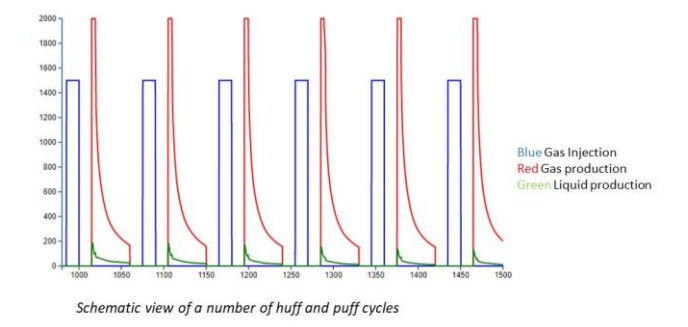
When planning an EOR campaign, or when analysing the early results from a well/pilot, a reservoir simulator (together with a model of the subsurface) is the only tool available to predict the production and the economics of the project.
6X has been successfully used in many EOR projects, for example see the 2021 URTeC paper: 5649 A Simulation Study to Evaluate Operational Parameter Ranges for a Successful Cyclic Gas Injection in Different Areas of Eagle Ford by M. Gaddipati, B. Basbug, T. Firincioglu of NITEC LLC.
Requirement for a tuned hydraulic fracture description
- Most EOR projects follow on from a period of natural depletion.
- A 6X model can be tuned to both the hydraulic fracturing data (pressures and flow back) and the subsequent production."
- This provides a solid basis to predict the behavior of the gas injection period.

Quick look prediction using a black-oil fluid description
- Gas injection at high pressures will typically form a supercritical fluid with the reservoir oil.
- Hence the simulator fluid description needs to take care of the full phase behavior.
- The most efficient solution is achieved by starting with an equation of state (EOS) fluid model and converting this to black-oil tables using 6X's internal converter.
- 6X's EOS to black-oil convertor ensures consistency and robustness.
More detailed prediction – composition fluid
- Given that the huff & puff process relies on a complex set of fluid behaviors, an EOS based compositional model is more accurate and provides extra information – typically the composition of the produced fluids."
- "The compositional model describes the fluid using pseudocomponents, typically 7-12 of them, where the black-oil model uses just 2 components."
- "As the number of components increase so does the simulation run time."
- "As the compositional model is only required when gas injection starts, an efficient workflow is to use the black oil model for the frac and initial production period, then to restart in compositional mode for the huff & puff phase."
- "In US light oils, the compositional and black-oil approaches have given broadly similar results."
Networks
Combine aquifer-scale models with injection and surface networks for rate-limited, facility-aware scenarios.
Multiple Realizations
Quantify storage capacity, plume extent, and risk metrics across stochastic parameters and scenarios.
Conventional and Unconventional Simulator with Fully Integrated Multiple Realizations (MR) capability
Quantification of uncertainty can be difficult and time consuming. Subsurface uncertainty exists from intrinsic geological complexity. A desire to quantify development options drives the successful application of Multiple Realizations; a pragmatic approach to optimize performance and maximize recovery from oil and gas reservoirs. It has successfully been applied from development appraisal stage projects to mature field projects and has increased project net present value.

6X Multiple Realization workflows
6X provides integrated functionality to create automated workflows performing hundreds of runs to quantify uncertainty in the following:
- Geological and fluid parameter sensitivities
- Experimental Design uncertainty quantification
- Assisted History Matching (AHM)
- Well and completion development selection
- Well and reservoir depletion forecasting


Unconventional reservoirs: well design to optimizing recovery
Many decisions are required to optimize recovery and economics from an unconventional well program. How many stages, how many clusters per stage, how much fluid and proppant to pump; how to determine the optimal well spacing and how many wells are required to develop a multi-bench drill spacing unit (DSU). A 6X Multiple Realization modeling workflow generates a range of outcomes to understand the hydraulic fracture growth and depletion to optimize EUR against net present value for a DSU.1
No hidden extras – a 6X license includes the MR module
The MR functionality exploits modern massively parallel architecture of 6X and runs on multi-CPU and multi-GPU systems. With the breakthrough and general availability of Cloud systems, clients can access 6X on Amazon AWS, Microsoft Azure and Google GCP.
Powerful Scripting
Encode custom trapping physics, monitoring responses, and reporting for CCS-specific regulatory studies.
Applications
From pilot design to full-field deployment, 6X supports every phase of your EOR program with accurate modeling and economic optimization across diverse unconventional reservoirs.
Cyclic Gas Injection (Huff & Puff) Campaigns
Design complete cyclic injection programs optimizing cycle timing, gas composition, and soaking periods. Model multiple cycles to maximize incremental recovery and project economics.
Foam Conformance Improvement in Fractured Reservoirs
Prevent gas channeling in fractured reservoirs using foam conformance modeling. Optimize surfactant strategies to keep gas in target zones and improve sweep efficiency.
EOR Feasibility Studies for Unconventional Reservoirs
Screen EOR opportunities and compare methods before capital commitment. Assess recovery potential, evaluate economics, and quantify uncertainties for informed investment decisions.
Pilot Design and Evaluation
Design EOR pilots with optimal well configurations and monitoring plans. Analyze early results to validate models and forecast full-field performance confidently.
Full-Field EOR Development Planning
Scale EOR from pilots to full-field deployment. Optimize well sequencing, facility design, and phased rollout to maximize NPV and recovery.
Economic Optimization of EOR Projects
Optimize EOR economics across multiple scenarios including timing, gas composition, and operational parameters. Balance incremental recovery against costs for maximum ROI.
Gas Injection Optimization (Rate, Timing, Composition)
Optimize injection rates, timing, and gas composition to maximize recovery efficiency. Balance compression costs, formation integrity, and economic returns.
Multi-Well EOR Operations
Model multi-well EOR accounting for interference and gas distribution. Optimize simultaneous or sequential injection to maximize uniform recovery across well pads.
EOR in Different Shale Basins (Eagle Ford, Permian, etc.)
Adapt EOR strategies for basin-specific challenges across Eagle Ford, Permian, Bakken, and other plays using field-validated modeling approaches.
Re-fracturing Combined with EOR
Combine re-fracturing with EOR to maximize recovery from mature wells. Optimize sequencing to achieve synergistic benefits beyond either technique alone.

Technical Capabilities
6X provides a comprehensive suite of technical capabilities specifically designed for EOR modeling in unconventional reservoirs, from custom scripting to advanced compositional simulation.
- Dynamic scripting for custom foam models
- Tracer capability for surfactant transport
- Black-oil fluid modeling
- Compositional fluid modeling (EOS)
- EOS to black-oil converter
- Multi-well modeling
- History matching capabilities
- Economic evaluation tools
- Phase behavior modeling
- Supercritical fluid handling
11. Custom foam model variables:
- Surfactant concentration
- Foam quality
- Velocities
- Pressure
- Saturation of phases
- Temperature effects
- Time decay modeling
- Surfactant adsorption
Get Started with 6X for EOR
See how 6X can help optimize your EOR projects and increase recovery factors

Our Latest News
Stay updated with Ridgeway Kite’s latest technology bulletins, case studies, and event highlights featuring the 6X simulator.
Geomechanics in 6X: why mean-stress-only models miss stress shadowing between stages, and how the full stress tensor captures stage-to-stage effects on SRV.
.png)
Enhanced geothermal systems (EGS) in 6X: HDR, fracture mechanics, implicit energy equation, and workflow. From EGSModeling.pdf.
.png)
URTEC 2023 triple porosity modelling with 6X. DOI and full paper access via Datapages, SEG, or OnePetro.
.png)
