/
6X for Unconventional
/

6X for Unconventional Reservoirs

Together at Last: Geomechanics, Hydraulic Fracturing and Flow Simulation in a Fully Integrated Model

Ridgeway Kite has built on its extensive experience in reservoir simulation solver techniques, and coupled this with the latest massively parallel computing systems to develop the 6X simulator.

Illustration

Infill Wells

Simulate multi-well pads and many fracture stages through completion, interference, and depletion in one lifecycle model.

Illustration

Tensile and Shear fractures

Capture mixed tensile and shear failure, fracture branching, and complexity by evolving both modes within coupled geomechanics and flow—not tensile-only simplifications.

Illustration

Stress Shadowing

Resolve stress shadowing across wells and stages by coupling geomechanics with the full stress tensor, not mean stress alone.

Illustration

Re-fracturing

Evaluate re-fracture and infill programs to improve drainage and mitigate asymmetric fracture growth.

Illustration

N-porosity - Unconventional Physics

Represent naturally fractured and multi-scale pore systems in unconventional rocks with dual- or N-porosity formulations that resolve matrix–fracture transfer and fluid exchange.

Illustration

EOR

Extend unconventional models into gas-based EOR such as huff-and-puff to forecast incremental recovery.

Illustration

Breaking Stress/Hysteresis

Apply stress-dependent permeability, net-stress tables, and hysteresis as fractures open, propped, and close.

Illustration

Proppants and Gels

Track proppant and gel/breaker tracers to capture viscosity, placement, and conductivity in hydraulic fractures.

Illustration

Foam

Build foam models with dynamic scripting and surfactant tracers to limit gas mobility in fractures and improve conformance.

Illustration

Huff n Puff

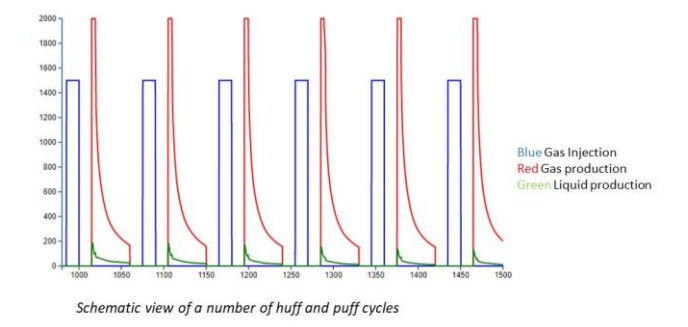
Simulate full huff-and-puff cycles to tune soak times, rates, and gas composition for incremental oil.

Illustration

Networks

Tie unconventional wells and fractures to surface gathering and facilities so forecasts honor routing, pressures, and operational constraints across the system.

Illustration

Uncertainty Analysis (Multiple Cases)

Drive uncertainty quantification and development choices with integrated multiple-realization workflows, experimental design, and side-by-side deterministic cases.

Illustration

Powerful Scripting

Automate pad- and field-scale unconventional studies with scripting scenarios, custom physics hooks, QC, and repeatable reporting.

/01/

Infill Wells

Manage spacing and timing while limiting fracture driven interactions between infill and parent wells.

6X: Model pads to determine infill well spacing and bench development sequencing

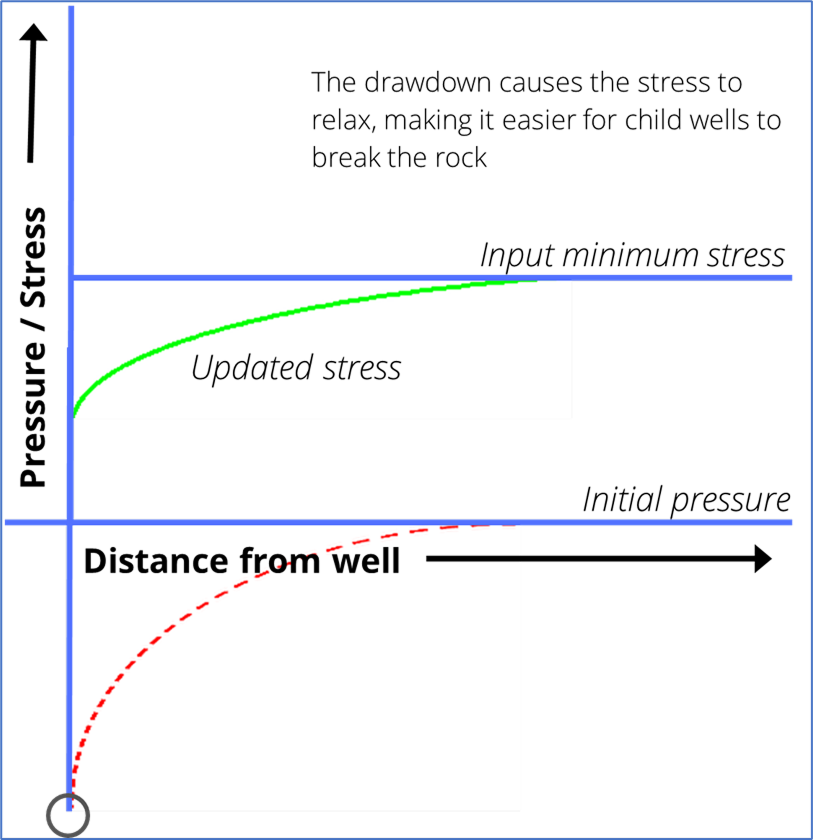
Operators are focused on multi-well infill pad development programs to develop drill spacing units (DSUs) using fiscal discipline to generate free cash flow. Infill well design, spacing and timing become critical. Infill wells are impacted by the parent well pressure depletion and the associated change in the stress magnitude in the depleted drainage area.

Infill wells drilled offset to parent wells have experienced slurry loss during treatment due to fracture-to-fracture interactions between the infill and parent well hydraulic fractures. The change in stress magnitude leads to asymmetric fracture growth from the infill well into the depleted region of rock around the parent well.

These effects typically impair the performance of the infill well. Fracture driven interactions (FDIs) that lead to proppant reaching the parent well are detrimental, eroding pad production efficiency and value.

6X: Infill well spacing and timing to optimize for economic value through pad models

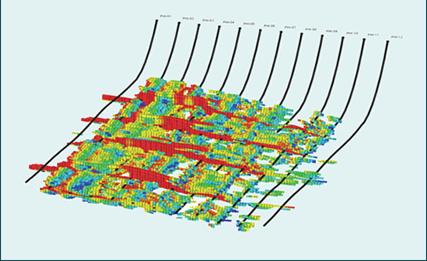
6X has the unique ability to model the changes in saturations, pressure and net mean stress simultaneously in one model. This capability can be used to optimize an infill well pad development program for multiple benches for a DSU. 6X captures the fracture driven interactions as the change in net mean stress is modeled through the infill well treatments and the depletion phase. The model dynamically captures the fracture opening; the propping at the end of the treatment; the compression of the fracture pore volume during depletion; and the loss of fracture conductivity with reservoir depletion. Stochastic multiple realization sensitivities can be performed using a single 6X license to assess the impact of treatment design on FDIs; the infill well count; spacing; the infill well timing; zippering and the impact of different operating strategies to understand and optimize the economic return on investment or net present value.

Example of interference on parent well from infill well
Ternary plot showing fracture to fracture interference
6X Infill Well and Pad Model Functionality:
  • Optimize infill well spacing and timing
  • Design selection: cluster spacing, clusters per stage and treatment volumes
  • Hydraulic fracture treatment model including limited entry
  • Dynamic stress change through hydraulic fracture treatment and depletion
  • Proppant transport and proppant trapping model
  • Fracture conductivity dynamically changes as hydraulic fractures are formed and close
  • Infill well fracture driven interactions between infill and parent wells

Use 6X to optimize your infill well completion from stage treatment to multi-well pad optimization.

/02/

Tensile and Shear Fractures

Manage spacing and timing while limiting fracture driven interactions between infill and parent wells.

/03/

Stress Shadowing

Model the effect of well and stage spacing on the induced stress field using the full stress tensor.

6X: Using the full stress tensor to predict stress shadowing

Stress shadowing occurs when the induced stress field from the hydraulic fracturing of one stage influences subsequent stages. For this to occur the stages need to be sufficiently close for the induced stress field to propagate to the next stage. The closer the stages the more pronounced the effect is likely to be.

To model stress shadowing the simulator needs to include a geomechanics model. It turns out that this model should solve at least for the normal stress tensor components, rather than just the hydrostatic mean stress. The 6X Simulator has this capability.

Solving only for mean stress

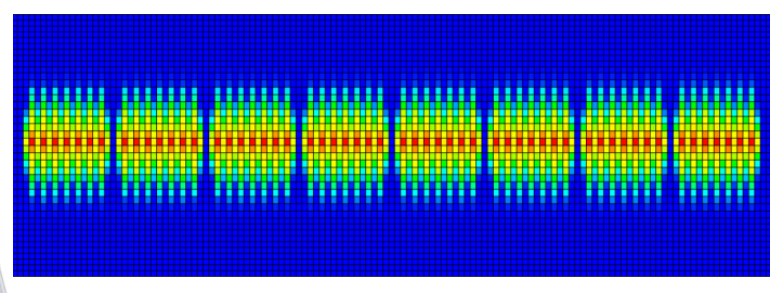
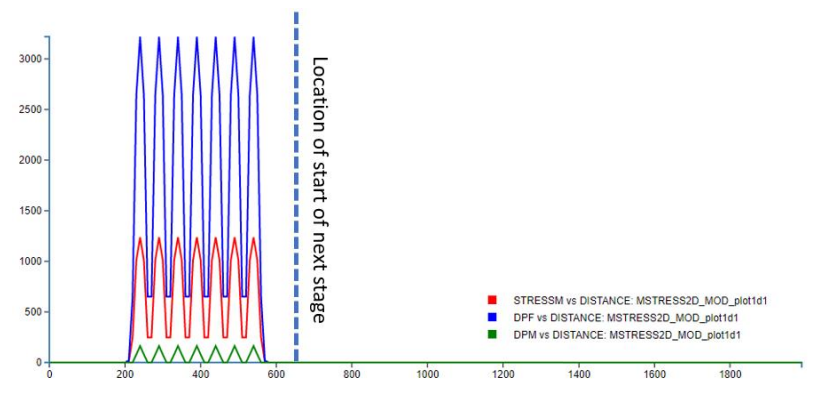
The simplest geomechanics model in 6X solves only for the average of the normal stress tensor components (the mean stress). Using this model for a single well study with close stage spacing we see no stress shadowing effect. The figure below shows the dynamic permeability induced by the fracturing of 8 consecutive stages. Clearly, each stage shows the same pattern of SRV generation regardless of the stress field generated by the previous stages.

To understand why this happens we plot the mean stress field along the path of the well just before the start of injection into stage 2.

The plot shows that the mean stress (red) is simply a multiple of the fracture pressure (blue) and matrix pressure (green). Since neither of these properties have significant values at the location of the second stage (dotted blue) there will be no stress shadowing effect modeled.

Solving for the full stress tensor

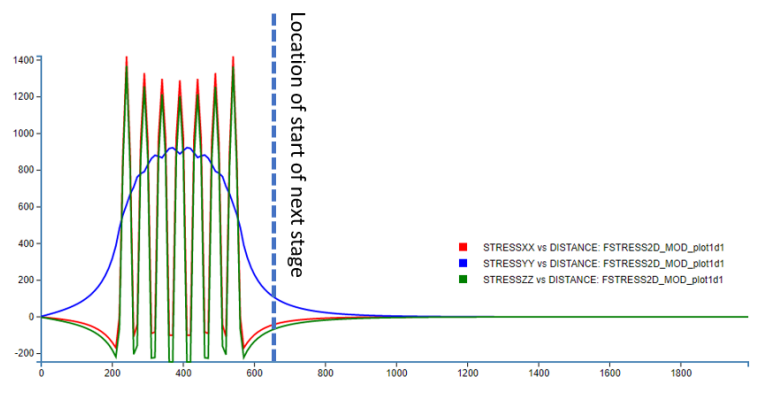
6X also has a more advanced geomechanics model, which can solve for each individual component of the stress tensor and use these values to predict the rock breakage in more detail. Using this model and plotting the normal stress tensor components along the well trajectory before the start of stage 2 we see an interesting effect.

The individual normal stress components are non-zero at the location of the next stage, despite the fact that they sum to zero, giving zero mean stress. Consequently we can expect stress shadowing effects when taking account of these components. The plot below shows the dynamic permeability, which clearly shows the influence of the stress field on subsequent stages.

/4/

Re-fracturing

Optimize Re-fracture Design to Maximize Drainage and Avoid Asymmetric Fractures.

Modeling Re-fracture and Infill Wells to Maximize Drainage and Avoid Asymmetric Fractures

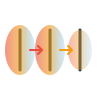
Re-fracturing a well has two primary benefits: (i) Providing incremental production from a well with an early generation completion by re-fracturing with tighter cluster spacing; (ii) Elevating stress and pressure prior to fracturing an adjacent infill well to prevent EUR loss due to asymmetric fracture growth.

How can you design re-fracture well programs to maximize well economics?

6X uniquely incorporates the stress change from fracture creation and reservoir depletion in one model. The simulator models the stress increase and decrease of the initial completion execution and subsequent depletion; Also, the stress increase of the re-fracture and infill well completions followed by the stress decrease as the wells deplete.

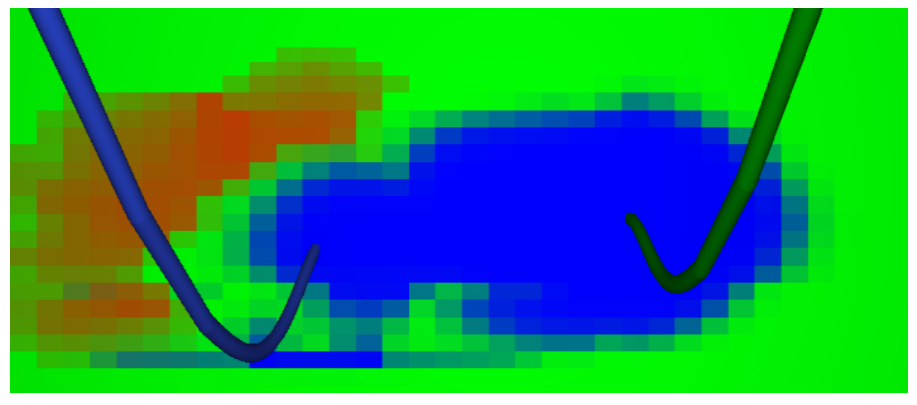
With the Implicit Stress Solution, the above model shows virgin pressure between the original clusters. [The rock must be hydraulically re-fractured to produce.]

Assess and optimize your refracture design to improve well performance, model stress changes and design adjacent infill wells to avoid asymmetrical fractures and maximize reservoir drainage. Validate historical stress and well performance to assess new re-fracture opportunities using cemented or an expandable liner combined with extreme limited entry. Evaluate improved cluster efficiency to increase well EUR and maximize drainage.

6X – Re-fracture Design Parameters:
  • Assess dynamic stress changes for the life of wells
  • Design re-fracture cluster locations with limited entry perforations
  • Optimize adjacent well design to avoid asymmetrical fractures
  • Optimize proppant and fluid pump schedule per stage

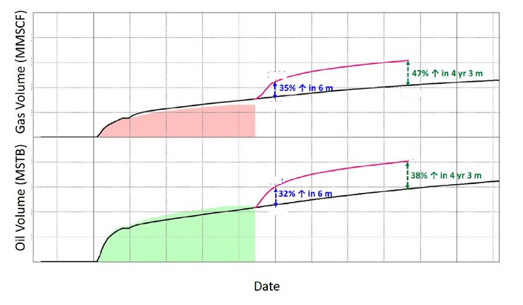
In a recently published field test by an operator, 6X confirmed that incremental oil production increased by 32% over a 6-month forecast after re-fracturing a well.

/5/

Unconventional Physics

6X models the unique physics of unconventional reservoirs including multi-porosity systems and vapor-liquid equilibrium.

N-Porosity

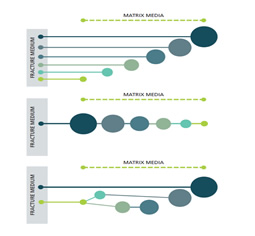
Multi Porosity 6X has multi-porosity capabilities, in which different porosity systems (e.g. fractures, kerogen, sandstone) can be arbitrarily connected in a hierarchical model. They can be connected directly, in serial, or more generally as seen in the image above.

Multi Porosity – Illustration shows the variety of matrix-fracture connections possible in the simulator

Vapor-Liquid Equilibrium

The presence of high capillary forces in very small pores in unconventional reservoirs results in suppression of the bubble point pressure. To correctly model this, 6X solves the vapor-liquid equilibrium problem consistent with capillary pressures to make this correction.

/6/

EOR

Optimizing EOR Through Cyclic Gas Injection in Unconventional Reservoirs.

EOR pilot design

  • Injectants - Choose and specify the injection fluid (gas, solvent, surfactant, foam, water-alternating-gas, etc.) and how its phase behavior, miscibility, and mobility compare to resident oil and water so the pilot tests the right recovery mechanism.
  • Injection rate and volume - Set rates and cumulative volumes that balance contact efficiency, facility limits, and economics while staying within mechanical and operational constraints.
  • Pressure constraints - Respect fracture gradient, caprock integrity, well mechanical limits, and regulatory or lease pressure ceilings so injection improves recovery without compromising containment or wellbore integrity.
  • Cycle time and shut-in period - For cyclic processes (for example huff-and-puff), tune soak and shut-in duration so injectant can imbibe and mix in the matrix, pressure can redistribute, and production captures incremental oil without excessive downtime.
EOR Application
  • Well scheduling - Sequence which wells inject, produce, or rest so interference, pattern sweep, and facility usage support the pilot or full-field rollout.
  • Containment - Account for seals, aquifers, faults, and top/stratigraphic traps so injected fluids stay in the target interval and do not create loss or compliance risk.
  • Natural fractures and fracture corridors - Represent high-permeability pathways that can short-circuit injectant, improve sweep in some directions, or cause early breakthrough; design and forecasts should reflect that heterogeneity.
  • Matrix contact (N-porosity needed) - Where oil sits largely in low-permeability matrix and fractures dominate flow, dual- or N-porosity descriptions help capture transfer between fractures and matrix and avoid optimistic recovery if only fractures are well connected.
  • Injectant availability - Tie forecasts to realistic supply (CO₂ source, gas plant, water treatment, chemicals, compression, and pipeline or trucking capacity) so schedules and economics match what can actually be delivered.

/07/

Fracture Mechanics & Breaking Stress

Advanced fracture mechanics modeling including stress-dependent permeabilities, gels and proppants, and rock compaction.

Stress Dependent Permeabilities:

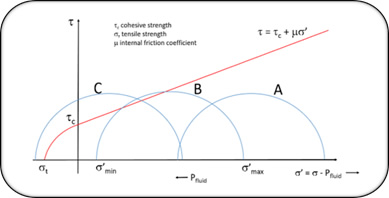
Fracturing events are captured in 6X using regional tables of permeability modifiers versus net stress, which are applied dynamically to modify the reservoir flows. The table modifiers are either applied directly, or conditionally using a Mohr-Coulomb model and an input stress field. Several hysteresis models are also available to model the closing of fractures.

In addition, special consideration is given to the effects on well PIs and flows between different porosity systems, and provision is made to model background effects in nearby zones with transmissibility compressibilities.

Gels and Proppants:

The 6X simulator has a tracer capability in which extra fluid components are carried around with the reservoir fluids, but which do not on their own affect the flow solution. They can be used as markers, to trace the flow of injected or initially in-place fluids through the reservoir throughout a simulation run.

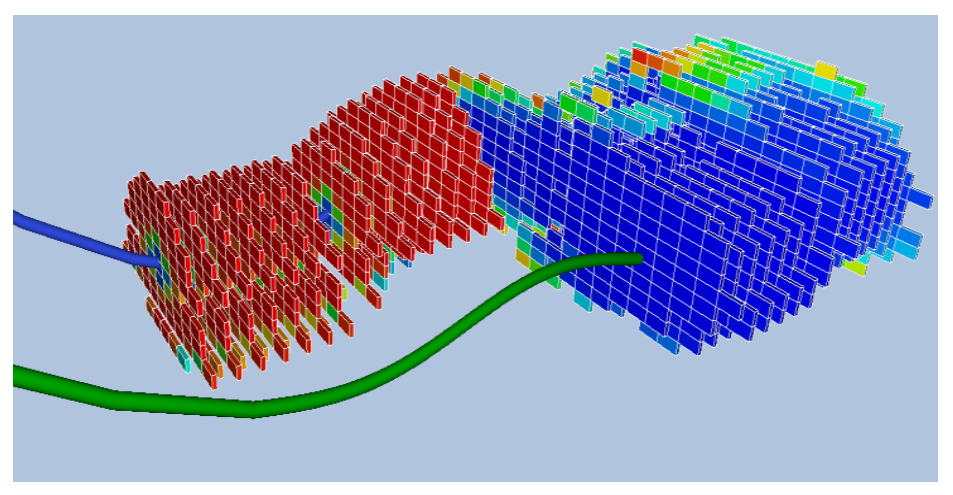
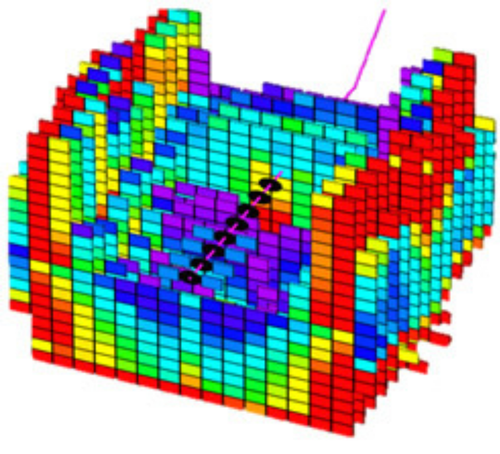
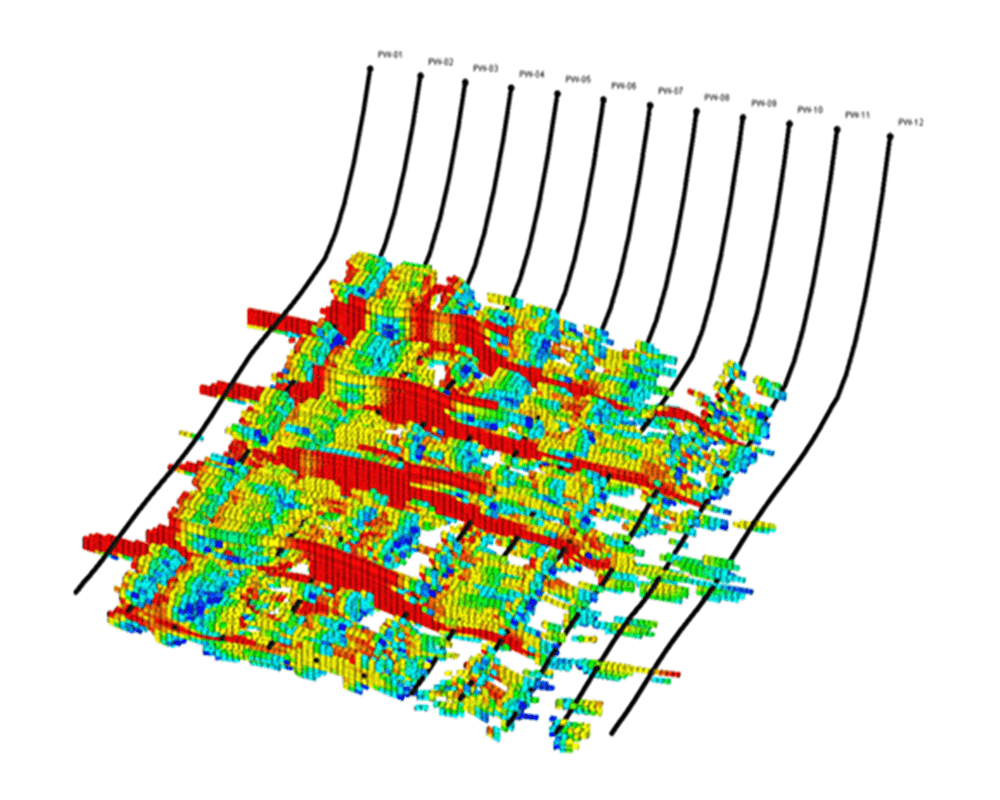
Proppant – Example above with a cropped model displaying density of trapped proppant in a model (highest values in red).

6X uses the tracer facility in unconventionals for modeling the effects on flow of gels and proppants. Gels and gel breaker properties can be specified and their combined effect on fluid viscosity modulated. Proppant density can also be accounted for, with special consideration given to the prevention of ingress into non-fracture matrix, and to the differential flow of proppant in a fluid due to the effects of gravity.

Rock Compaction

Rock compaction models include a standard rock compressibility input, or tables of compressibility versus net stress, including hysteresis effects.

Rock Deformation

/8/

Proppant Optimization

Sizing Your Treatment To Maximize Well Economics.

Simulate your Wells from Proppant and Fluid Pumping to Reservoir Depletion in 6X

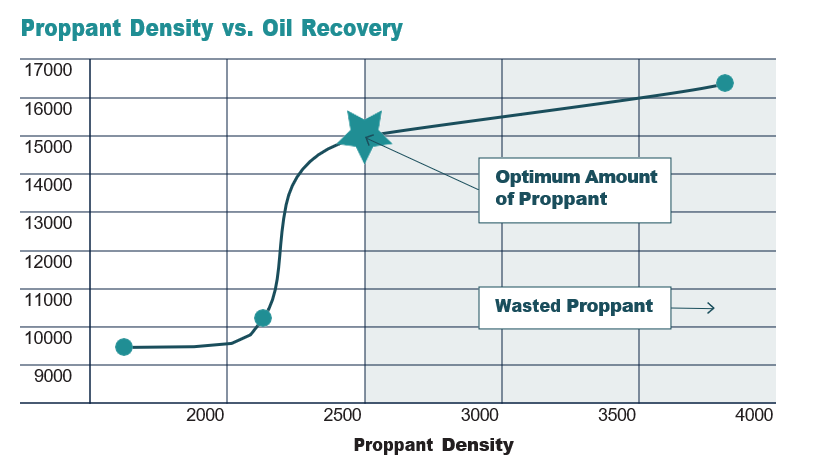
Proppant selection, proppant concentration and the pump schedule are key design parameters for well hydraulic fracture treatments.

In recent years, in attempting to increase production, operators have increased the proppant concentration and the fluid volume pumped. Fracturing fluids have evolved from gel-fracs to slickwater fracs, recently with high-viscosity friction reducers (HVFR) and operators are pumping cheaper regional sand in order to reduce costs.

So how can you optimize your treatment size to maximize well economics?

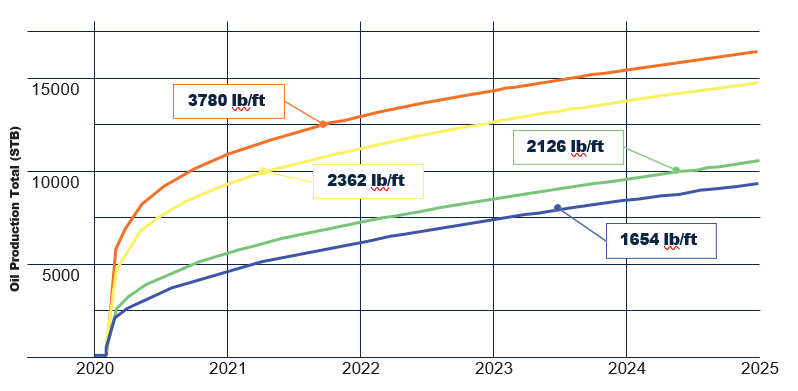
6X uniquely incorporates fracture creation and reservoir depletion in one model. It can model production forecast sensitivities over a range of proppant concentrations for economic evaluation and design optimization.

Proppant selection, proppant concentration and the pump schedule are key design parameters for well hydraulic fracture treatments.

In recent years, in attempting to increase production, operators have increased the proppant concentration and the fluid volume pumped. Fracturing fluids have evolved from gel-fracs to slickwater fracs, recently with high-viscosity friction reducers (HVFR) and operators are pumping cheaper regional sand in order to reduce costs.

So how can you optimize your treatment size to maximize well economics?

6X uniquely incorporates fracture creation and reservoir depletion in one model. It can model production forecast sensitivities over a range of proppant concentrations for economic evaluation and design optimization.

Physics for Proppant Transport:
  • Models for particle settling
  • Tortuosity modifiers for complex fractures
  • Fluid viscosity modeling, including breakers
Proppant and Fluid Design Parameters:
  • Proppant type and fluid type
  • Proppant concentration and fluid volume per stage
  • Proppant and fluid pump schedule per stage
History Matching Well Hydraulic Fracture Treatments:
  • Pressure and rate match for injection and production phases
  • Proppant and fluid tracers by stage for tracking and flowback
  • Propped, SRV and fracture-matrix connection
  • Dynamic stress changes due to pumping and depletion
/9/

Foam

Control gas mobility and conformance in fractured rock with surfactant foam and custom kinetic models.

Using 6X to model foam creation and its effect on gas mobility

In EOR foam can be particularly useful in highly fractured reservoirs such as in unconventional and tight oil fields. Here the primary challenge is to maintain gas within the target formation and prevent it from escaping into adjacent wells.

Without conformance improvement techniques, the gas might simply rush through the high conductivity fractures, channels, or weakness planes in the reservoir.

Foam generation

Foam is created by injecting a mix of water and surfactant into the reservoir. Surfactants decrease surface tension, enabling gas to be encapsulated in water-based films, thus generating foam. The foam then decreases the mobility of the gas by increasing its viscosity.

Foam modelling within 6X

Traditional simulator foam models use empirical methods to represent surfactant-induced foam generation, selecting certain variables while leaving others out.

6X enables dynamic scripting, which allows for the creation of custom foam models that incorporate userderived data and insights.

6X employs tracers to simulate the transport of surfactants, carried by the aqueous or liquid phases.

Custom foam models in 6X can be used in simulating the entire life-span of foam in a reservoir, including its
generation, stability, and collapse.

Variables such as surfactant concentration, foam quality, velocities, pressure, saturation of phases, and temperature effects are all taken into account.

The models also simulate the time decay of foam effectiveness and collapse, and the adsorption of surfactant into the rock as a function of surface area.

For this type of foam modeling it is essential to utilize multi-well models to account for connectivity among the wells. 6X is fully equipped to integrate these models into its simulations.

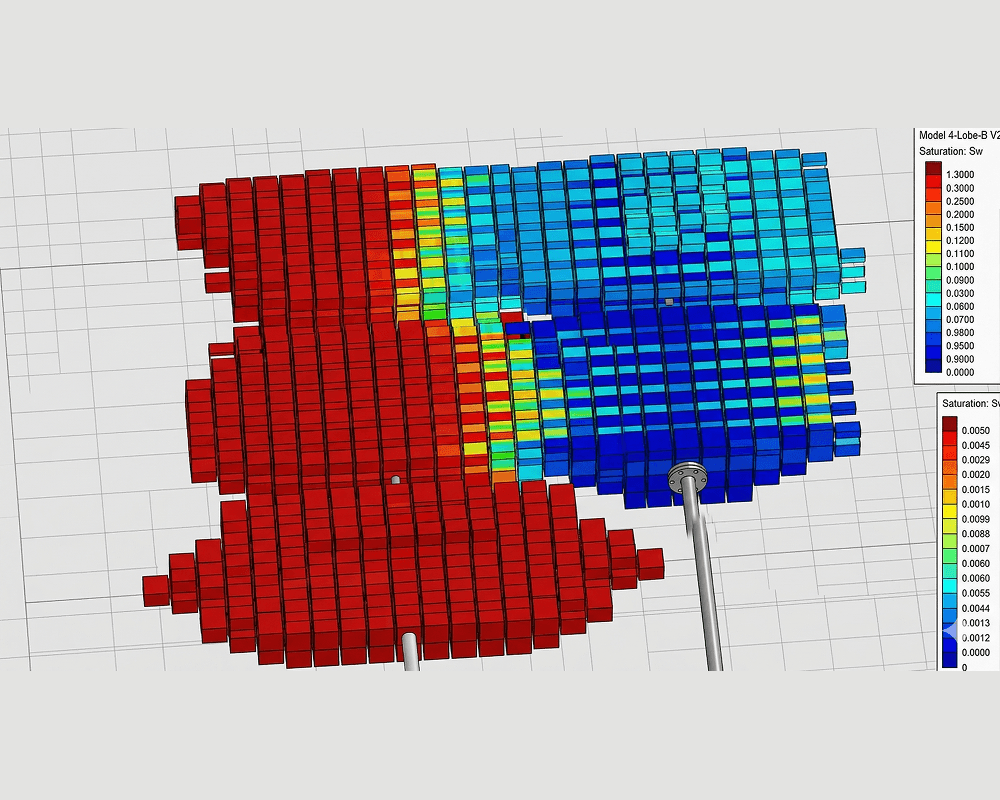
The following figures display gas saturation within the fractures, filtered to highlight only the middle part of the reservoir. Gas is injected from the right side of the wells and subsequently migrates to the left side. In the second figure, the introduction of a surfactant has effectively limited the spread of gas.

/10/

Gas Huff-n-Puff

Model cyclic gas injection with soak and production periods to optimize cycle design in unconventionals.

The hydraulic fracturing of wells in unconventional reservoirs has resulted in high initial oil production. However the decline rates are very high with low recovery factors. Recently, Enhanced Oil Recovery (EOR) through cyclic gas injection (huff & puff) has increased recovery factors in the Eagle Ford and is being investigated for use in other shale basins.

When planning an EOR campaign, or when analysing the early results from a well/pilot, a reservoir simulator (together with a model of the subsurface) is the only tool available to predict the production and the economics of the project.

6X has been successfully used in many EOR projects, for example see the 2021 URTeC paper: 5649 A Simulation Study to Evaluate Operational Parameter Ranges for a Successful Cyclic Gas Injection in Different Areas of Eagle Ford by M. Gaddipati, B. Basbug, T. Firincioglu of NITEC LLC.

Requirement for a tuned hydraulic fracture description

  • Most EOR projects follow on from a period of natural depletion.
  • A 6X model can be tuned to both the hydraulic fracturing data (pressures and flow back) and the subsequent production."
  • This provides a solid basis to predict the behavior of the gas injection period.

Quick look prediction using a black-oil fluid description

  • Gas injection at high pressures will typically form a supercritical fluid with the reservoir oil.
  • Hence the simulator fluid description needs to take care of the full phase behavior.
  • The most efficient solution is achieved by starting with an equation of state (EOS) fluid model and converting this to black-oil tables using 6X's internal converter.
  • 6X's EOS to black-oil convertor ensures consistency and robustness.

More detailed prediction – composition fluid

  • Given that the huff & puff process relies on a complex set of fluid behaviors, an EOS based compositional model is more accurate and provides extra information – typically the composition of the produced fluids."
  • "The compositional model describes the fluid using pseudocomponents, typically 7-12 of them, where the black-oil model uses just 2 components."
  • "As the number of components increase so does the simulation run time."
  • "As the compositional model is only required when gas injection starts, an efficient workflow is to use the black oil model for the frac and initial production period, then to restart in compositional mode for the huff & puff phase."
  • "In US light oils, the compositional and black-oil approaches have given broadly similar results."
/11/

Networks

Tie unconventional forecasts to surface gathering and facility constraints using integrated network modeling.

/12/

Multiple Realizations

Fully integrated Multiple Realizations capability - integral to every decision.

Conventional and Unconventional Simulator with Fully Integrated Multiple Realizations (MR) capability

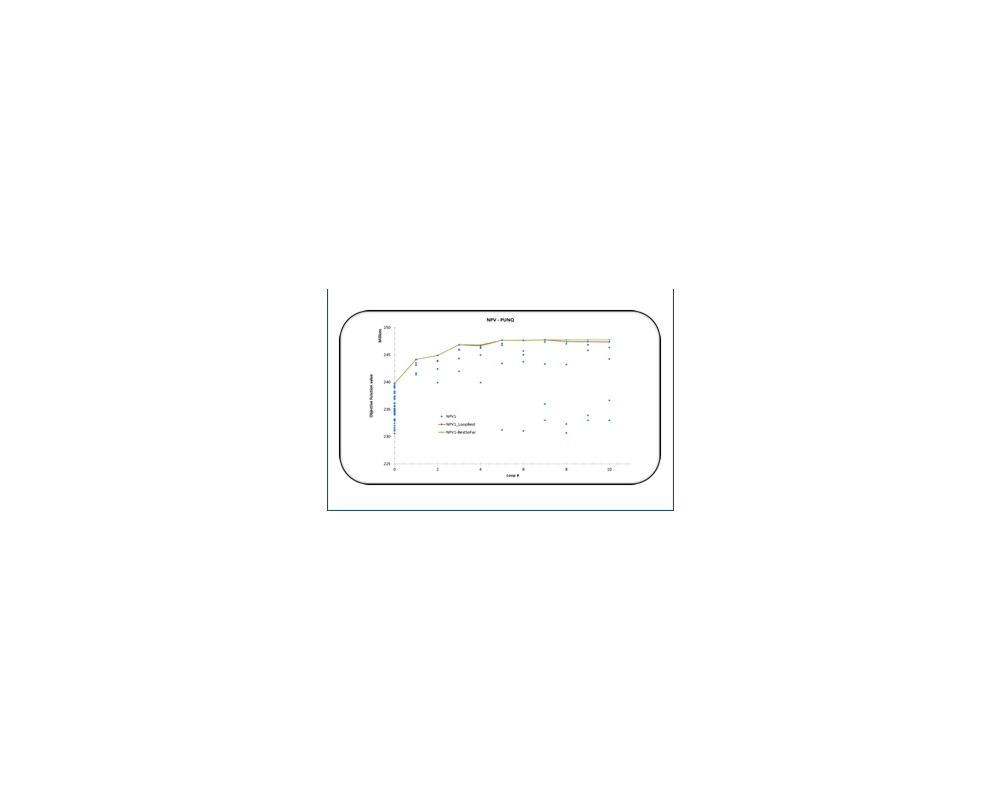
Quantification of uncertainty can be difficult and time consuming. Subsurface uncertainty exists from intrinsic geological complexity. A desire to quantify development options drives the successful application of Multiple Realizations; a pragmatic approach to optimize performance and maximize recovery from oil and gas reservoirs. It has successfully been applied from development appraisal stage projects to mature field projects and has increased project net present value.

6X Multiple Realization workflows

6X provides integrated functionality to create automated workflows performing hundreds of runs to quantify uncertainty in the following:

  • Geological and fluid parameter sensitivities
  • Experimental Design uncertainty quantification
  • Assisted History Matching (AHM)
  • Well and completion development selection
  • Well and reservoir depletion forecasting
Unconventional reservoirs: well design to optimizing recovery

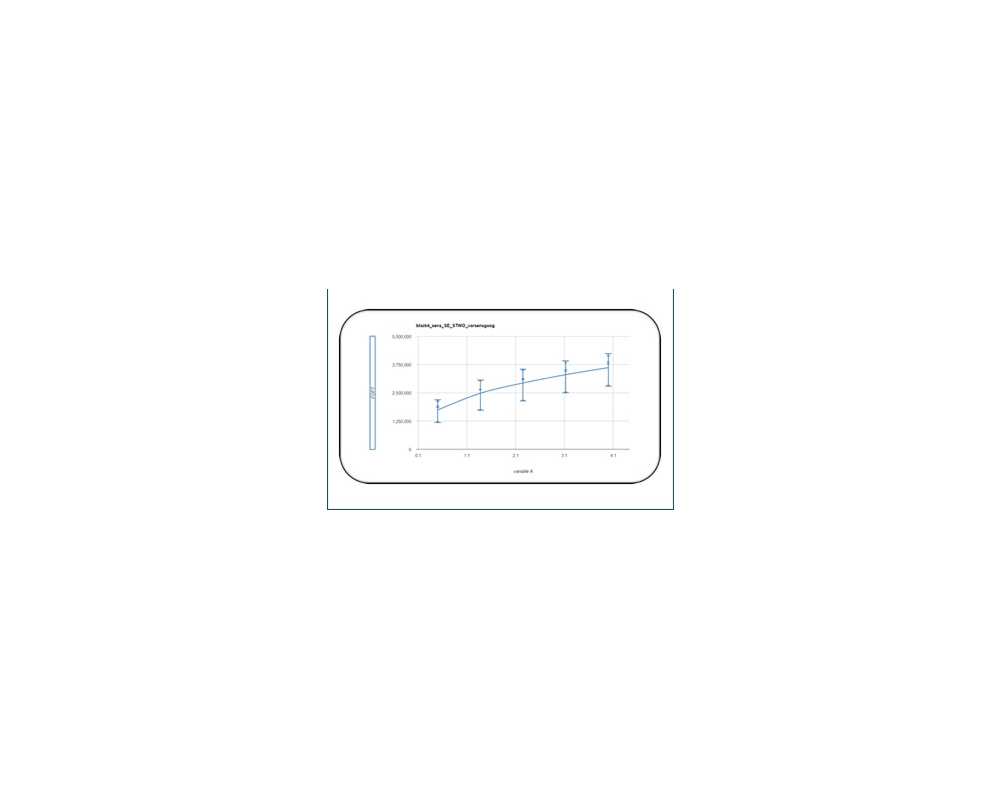
Many decisions are required to optimize recovery and economics from an unconventional well program. How many stages, how many clusters per stage, how much fluid and proppant to pump; how to determine the optimal well spacing and how many wells are required to develop a multi-bench drill spacing unit (DSU). A 6X Multiple Realization modeling workflow generates a range of outcomes to understand the hydraulic fracture growth and depletion to optimize EUR against net present value for a DSU.1

No hidden extras – a 6X license includes the MR module

The MR functionality exploits modern massively parallel architecture of 6X and runs on multi-CPU and multi-GPU systems. With the breakthrough and general availability of Cloud systems, clients can access 6X on Amazon AWS, Microsoft Azure and Google GCP.

/13/

Powerful Scripting

Extend 6X with scripting for bespoke physics, batch runs, and automated reporting.

Well Spacing Optimization

Spacing & Clustering

Determine optimal lateral spacing and cluster placement to maximize reservoir contact while minimizing fracture-driven interactions. 6X models the full stress field changes during multi-well development, helping you balance capital efficiency with EUR optimization across your DSU.

01

Completion Design Optimization

Completion Design

Calibrate models through parent well history matching, then optimize child well completion designs for maximum ROI. Test stage spacing, perforation cluster designs, proppant concentrations, and fluid volumes to find the economic sweet spot for your asset.

02

Infill Well Planning and Timing

Infill Planning

Model the pressure depletion and stress changes from parent wells to design infill programs that avoid asymmetric fracture growth and EUR degradation. Optimize the sequencing and timing of infill wells to maximize value while managing fracture-driven interactions.

03

Re-fracturing Program Design

Re-Frac Design

Evaluate re-fracture opportunities to restore production or prepare wells for adjacent infill development. 6X's integrated geomechanical modeling captures how depletion and stress changes affect re-fracture geometry, enabling you to design treatments that maximize incremental recovery.

04

Multi-Bench DSU Development

Multi-Bench Development

Plan the complete development sequence across multiple benches within your drilling spacing unit. Model the interaction between benches, optimize stacking order, and determine the timing that delivers the best economic outcome while managing subsurface complexity.

Read More
05

EOR Feasibility Studies (Huff-and-Puff)

EOR & Gas Injection

Assess enhanced oil recovery opportunities through gas injection processes. Model the complete cycle from injection through soaking to production, accounting for compositional effects and pressure changes unique to unconventional reservoirs.

06

Pad Development Optimization

Pad Optimization

Design complete pad development programs from first spud to final completion. Optimize the drilling and completion sequence, manage stress shadowing across the pad, and forecast production under various development scenarios to maximize NPV.

Read More
07

Production Forecasting and Uncertainty Analysis

Forecasting & Risk

Leverage integrated multiple realizations to quantify subsurface uncertainty and generate probabilistic forecasts. Run hundreds of sensitivities across geological parameters, completion designs, and operational variables to support confident decision-making.

08
/
01
/

Reservoir Modeling

Conventional and Unconventional reservoirs — from structurally simple to geologically complex — can be modeled with 6X in Black Oil or Compositional mode.

  1. Assisted History Matching (AHM) and uncertainty analysis with integrated multiple realizations
  2. Unconventional reservoir modeling with a multi porosity planar fracture solution for efficiency
  3. Proppant and fluid pump schedules; proppant transport and tracking
  4. Hydraulic fracturing and a dynamic geomechanical stress solution
  5. Development optimization
  6. Discretized wells
  7. Scripting
  8. Massively parallel extensible architecture
01
/
02
/

Unconventional Lifecycle

For Unconventional reservoirs, 6X models the life cycle of multi-well DSU; from the fracturing of the first well through to the end of production of the last well. The model accounts for fracture generation, closure and well interference.

02
/
03
/

Unified Simulation

6X is a single model used for both the hydraulic fracturing and depletion periods. Incorporating the physics for the dynamic geomechanical stress change, the model captures the impact of infill wells on parent wells enabling the user to match observed data and evaluate different development scenarios including:

  1. Well placement and well spacing
  2. Well timing and completion design
  3. Proppant and fluid placement
  4. Re-fracturing and huff-and-puff EOR gas injection
03
/
04
/

Modern Architecture

The modern design of 6X delivers consistent results across all platforms whether running on multi-CPU, multi-GPU or Cloud systems.

04
Illustration

Fully Integrated Modeling

Unlike traditional workflows that require multiple software packages, 6X integrates geomechanics, hydraulic fracturing, and flow simulation in a single model.

Illustration

Faster Simulation Times

Built on massively parallel architecture, 6X delivers simulation speeds that enable multiple realizations and comprehensive sensitivity analysis.

Illustration

Accurate Fracture Modeling

6X captures stress-dependent permeabilities, proppant transport and settling, and the interaction between propped and unpropped fracture networks.

Illustration

Optimized Capital Deployment

6X helps you deploy capital where it generates the highest returns while avoiding value-destroying well interactions.

Illustration

Proven Cost Savings

Operators have achieved 32% production increases through optimized re-fracture designs, improved EUR through better infill well spacing, and reduced completion costs through stage count optimization.

Illustration

Scalable Performance

6X's extensible architecture supports CPUs, GPUs, and cloud deployment, scaling seamlessly from single-well analysis to full-field development planning .

Illustration

Industry-Proven Technology

Built on decades of reservoir simulation expertise and validated through real-world field applications, 6X delivers results you can trust. The integrated approach has been proven across major unconventional plays.

Illustration

Comprehensive Uncertainty Management

The fully integrated Multiple Realizations module (included with every license) enables automated workflows for assisted history matching, experimental design, and probabilistic forecasting.

Get Started with 6X for Unconventional Reservoirs

See how 6X can help optimize your unconventional reservoir development workflows

Request Demo
/
Blog
/

Geomechanics in 6X: why mean-stress-only models miss stress shadowing between stages, and how the full stress tensor captures stage-to-stage effects on SRV.

Project Image

Enhanced geothermal systems (EGS) in 6X: HDR, fracture mechanics, implicit energy equation, and workflow. From EGSModeling.pdf.

Project Image

URTEC 2023 triple porosity modelling with 6X. DOI and full paper access via Datapages, SEG, or OnePetro.

Project Image